Tag Archives: poetry

Last Days

Train poetry journal as posted my four part poem “Last Days” on its blog.

The poem once had an epigraph quoting the American poet Robert Duncan, who wrote in the 1960s, “Again and again we enter the last days of our civilization.” Fittingly, I think, “Last Days” ends with a beginning.

Last Days

1.

No one paid much mind at first.
A low murmur amid the hubbub.

When finally heard
alarms were late.

How do you stop a chain reaction
or keep calm with a fever?

2.

Many have seen the end of the world
as they knew it.

Last days before that end
must be special days.

Those living them must be special too.
We’ve always known.

3.

We do our best to be prepared
half-believe what our senses tell us.

Know one in the hand
for what it’s worth.

What’s left undone is yet to do
yet we did and did undo some things.


4.

We returned home in the waning light
chastened yet braced for new beginnings

sure we knew the way ahead
and wouldn’t make the same mistakes again.

This was not the moment for doubt.
We were of one mind, never so dangerous.

Colin Morton

Train poetry journal will include three other poems of mine in their next print journal, on sale across Canada.

Four poems on aging

The Canadian magazine The Typescript is honouring Robert Kroetsch with a selection of poems on getting old and older. Here is my contribution, poems called Lost, Senior Swim, CPR Practice, and Visitation. Do visit the other Canadian poets’ contributions to The Typescript’s feature.

Lost

It’s under something it’s
behind something it’s in
the right place for something else.

No it’s on something it’s
in front of something it’s where
you don’t see it because you know it’s not there.

It’s your only one it’s
always there when you need it it
will come to you in a minute.

It’s on the tip of your tongue it’s
what you used to do with whozit you know
what you were talking about just now.

It isn’t coming back it’s
as if it never was as if it’s
not what you thought it is at all.

Colin Morton

New poems by Colin Morton

Two excellent Canadian literary magazines found room for my work on their pages this winter.

I recommend you check them out, and to get an idea of the kind of work they print, you could start by reading my poems here.

Prism international, based in Vancouver, includes my “Tinnitus” in its new issue:

Tinnitus

I read John Cage and, in a silent room,
listened to the low thrum of blood in my veins,
the hiss of nerves in my head.
Proprioception I called it, after Olson.

For years I believed what I heard
was the microbiome of my inner ear –
cells living out their lives in there –
and I wondered about this thing called me.

How much of me is a population
of microbes doing I don’t know what
to or for me, living and dying
as I say these words?

Now I accent the first syllable,
call it tinnitus, as if that’s an explanation.
I told the doctor, I guess there’s little I can do.
You can complain, he said.

Waterloo, Ontario magazine The New Quarterly includes two of my poems, and I have written a blog post about one of them for the TNQ blog. Here are the poems.

Dark Flower

What fresh hellebore is this that flowers
deep purple, deeper than its shallow
sunny fellows?
How deep
to flower in winter, face frost
and snow, to know when to bow,
how not to break.
Burgundy bloom,
have you a tincture for me and my fellows?
A word to the wayward perhaps?
Or a charm to scare the devil
out of any who cross us?
Would you at least come live with me
and be my dark midwinter comfort?

Please forgive my forwardness.
You are, and that’s enough for me.

Nocturne

Wind in the branches
Whispering waves

How much of our poetry is
staging

the abalone bed for
a single small pearl

found on a petal
or a rainy street

on the crest of a breaker
in the beak of a raptor

in the depths of the sea
or the eye socket of a skull

If you could see its gleam
without the setting

you’d be left without
a poem to learn

It would turn in your mind
like a moon

Updating the Address Book

A new poem of mine is online this month at Bywords.ca

It captures a bit of the loneliness and isolation that many of us are feeling in lockdown.

Updating the Address Book

So many listings scratched out

and replaced with newer ones.

Here’s another out of date,

we haven’t been in touch for years.

When we met he lived in old town,

two rooms of a red brick house

leaning toward the St. Lawrence.

He made me tea, and I wondered

if it was safe amid hanging wires

for speakers and an over-worked fan.

One table housed kettle, toaster,

laptop and printer. A bungee

cord held the fridge door shut,

and a girlfriend slept in the other room.

Each place I’ve seen him since

has been a replay of that scene.

Disorder so thorough it must

begin inside, grow soulward with age,

unless saved by some great love.

Or maybe I’m wrong, after all,

you see what you expect to see.

Maybe that first time in Montreal

gave me a label to hang on him,

and maybe the label has faded now.

I may have read it wrong from the start,

it has happened before.

I wish I could see him now.

Ascent special issue, November, 2019

W. Scott Olsen is turning over the editorship of Ascent magazine after 25 years, and goes out with a special issue, including some compelling work from mainly American writers. I was a colleague of Scott at Concordia College, Moorhead, Minnesota, when he took over Ascent, already established for forty years or more, and moved it from Chicago.

Here are my three poems from the issue, all rather starry eyed, with links to the rest of the issue.

Stardust

I met a woman who said she stole
her father’s ashes from her mother’s home
spread them under her father’s microscope and saw
phosphorus constellations
shining.


Event Horizon

Does anything momentous happen
in the moment everything changes,
when a falling body crosses the line
between light and dark?

In the moment everything changes
is it an event at all
between light and dark?
Like the instant in debate

(is it an event at all?)
when you realize what you’ve said
– this instant in debate –
is fatal to your cause.

When you realize what you’ve said
and all your good reasons are past recall,
it’s fatal to your cause.
Or like one of those days

when all your good reasons are past recall
and nothing seems to happen.
Or like one of those days
you later see as the decisive moment

when nothing seems to happen
as a falling body crosses the line.
Later you see it’s the decisive moment,
the moment everything happens.


Broken Windows

(poem ending with a line by Louise Glück)

Shattered glass. And within each shard
a whole world of street and sky.

My mother laughs.
My father smokes.

Outside the house, with the slam of a door,
life begins.

On winter nights Orion chases across the sky.
Rigel, Betelgeuse. What’s the other?

The walk back from the bar alone is proof
the universe is expanding.

Leaves fall, then snow.
You want to know if there’s Christmas on other planets.

And if love is the answer.
Who said anything sillier, or better?

Find solace in that. Or in the poet’s words,
“the great plates invisibly shifting and changing.”

Three Poems ~ Colin Morton

Poetry online and in the family

We’ve been away from the computer a lot this summer, but have been keeping up appearances online, with poems at these wonderful web zines:

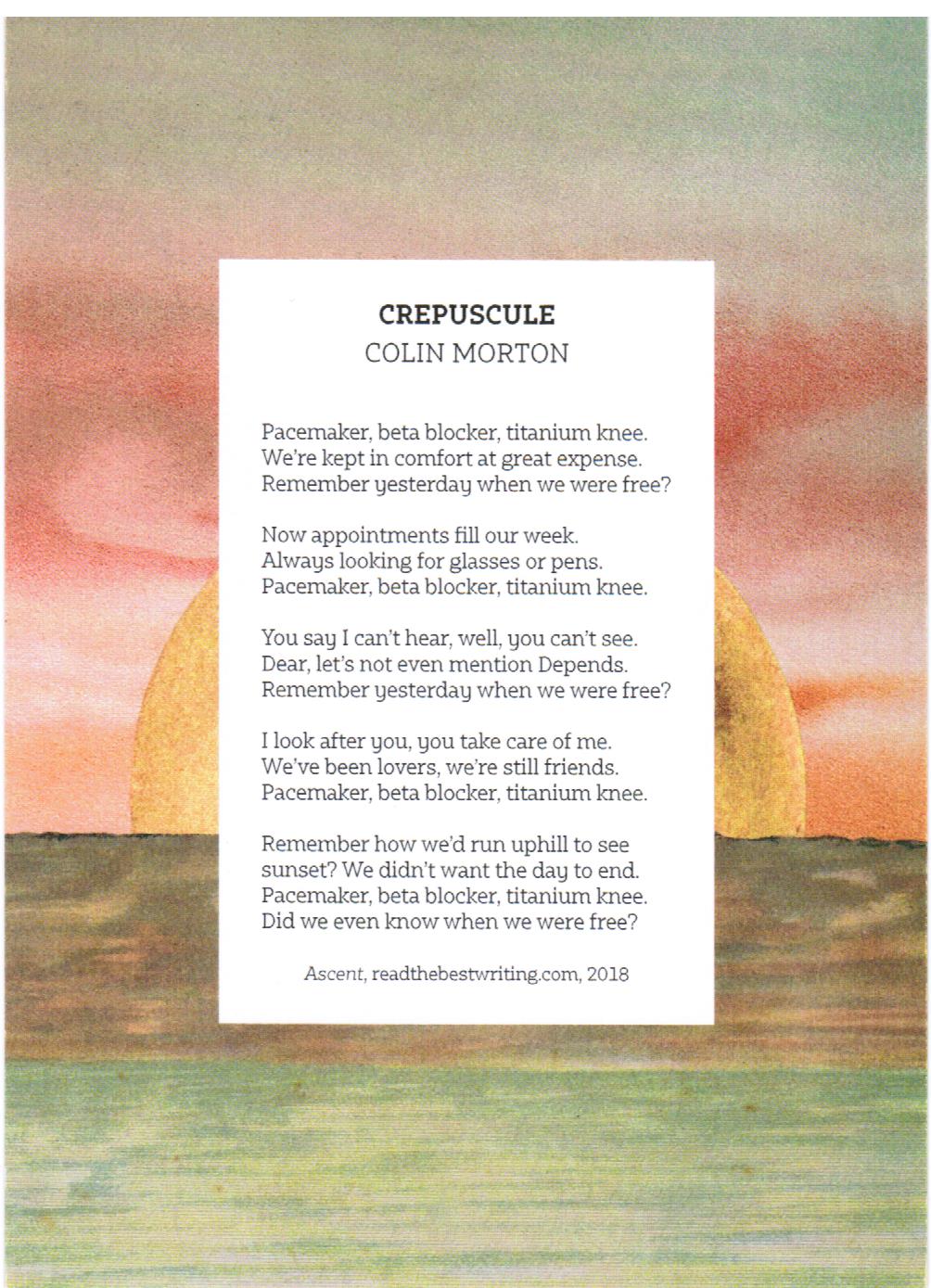
In the U.S., Ascent published my “Crepuscule” many years after editor Scott Olsen asked to talk about aging.

Valparaiso Poetry Review reached back millions of years with my poem “Footprints.”

In Canada, the new Juniper Review allowed me to give a birthday gift to my wife Mary Lee Bragg with the poem “Amnesia.”

Not incidentally, Mary Lee Bragg has just published her first full poetry collection, The Landscape that Isn’t Therefrom Aeolus House Press. It is the mature work of a lifetime, as you know if you heard her read at the Aeolus House launches in Toronto and Ottawa recently. She will be giving readings from the book in Ottawa at Tree in October and in Victoria at Planet Earth in January.


So we’re quiet here, and spend much of every day in silence, but all along, things are humming.

A.N. Morton (1922-2011)

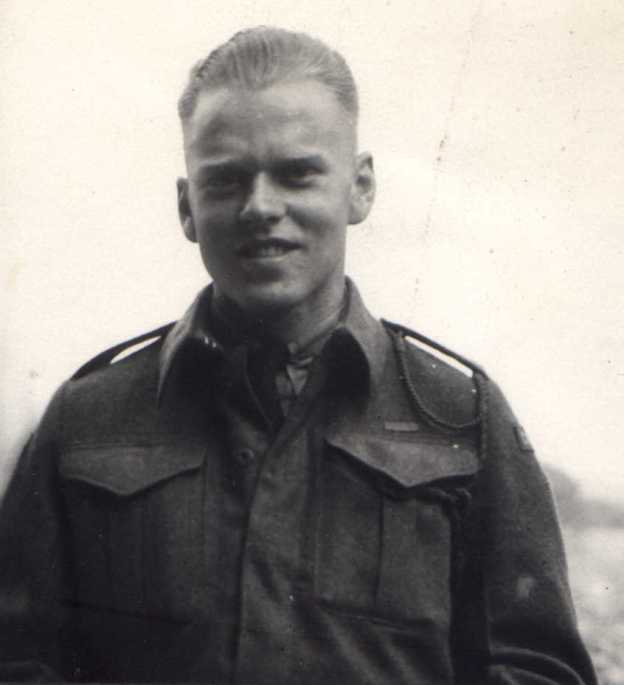
In the summer of 1945, in Holland awaiting repatriation, my father wrote and distributed a tabloid magazine for the members of his Royal Regiment group. Of course it included an interview with his chaplain and personal friend, Rev. Curry, who gave him some packages from home that could not be delivered, to help out. Thus my father “sold dead men’s cigarettes on the streets of Utrecht to pay the printer.” Here’s a poem I wrote much later:

VE Day

The day peace was declared

he stood ankle deep in the flooded Rhine.

While squadrons of air command passed overhead

he walked out into a pitted field

and said to himself, What now?

I’m out of a job.


That summer he kept busy

writing, designing, collecting stories

for his regiment’s tabloid.

Sold dead men’s cigarettes on the streets of Utrecht

to pay the printer.


At home he worked behind a desk

accounting for products he had no hand in.

He ran an office here or there,

moved cities, joined clubs, had a hobby or two.


And on cool spring nights

he sometimes went walking

out beyond the streetlights where

he’d stop and stare up

at the starless sky.


  • Colin Morton

Summer in review

20170703_135847.jpg

I’ve been quiet here, but a few things have been happening this summer. It’s the season for poetry in the park, and it began on Canada Day weekend, with readings at ArtFest in Kingston, Ontario, a fun gathering of artists, craftspeople and, in the big tent, poets. I was one of about 60 readers over the 3-day weekend, most of us included in a commemorative anthology edited by Kingston poetry impresario Bruce Kaufman. You can listen to the reading here.

20170723_150111


Home in Ottawa, small groups gathered to read poetry along the Poets’ Pathway, a 35-km trail through the green space around the city, the tramping ground of Canada’s “Confederation Poets” in the late 1800s. Here poets Mary Lee Bragg and Ronnie R. Brown confer under the trees on a summer Sunday afternoon.

On a sunny August evening, Ottawa poet Susan McMaster read with guitar accompaniment in an outdoor courtyard downtown.

Near the end of summer, on September 9, the Poet’s Pathway celebrated the completion of its mission by unveiling the last of 14 bronze plaques scattered along the length of the pathway, featuring poems by 19th century poets like Archibald Lampman and Pauline Johnson.

Our mayor and other officials turned out in tribute, and some stayed for a poetry reading by Canada’s poet laureate, George Elliot Clarke and Ottawa’s two (French and English) laureates, Andree Lacelles and Just Jamal the Poet.

20170909_163629And as fall begins, the literary life starts to get busy again. For a poet, however, being busy can look a lot like idling. It’s the quiet we seek, so we can hear our own inner voice and try to get down what it is telling us. Poet and blogger rob mclennan ask me to blog about my “typical writing day” and you can read about it here: https://mysmallpresswritingday.blogspot.ca/2017/09/colin-morton-my-small-press-writing-day.html

The Ghost of Burwash Hall

What to get Dad for Father’s Day … something I never wondered while he was alive, since he had no patience for such things. Five years after his death, here’s what I have: a series of poems, including a couple of actual quotations from his unpublished memoir, acknowledging that the central event of his life took place before I was born yet overshadowed his life, and to a lesser extent, mine, ever after. I was able to show Dad a few of these poems before he died, and he seemed content that, although I was a writer, I wasn’t a complete loss. Most of this series made it into my book Winds and Strings.


The Ghost of Burwash Hall

  1. No. 1 Canadian Army Course, University of Toronto, 1943

The regimental portrait curls at the ends

from years in the closet rolled in a tube

but the eye still goes to one face in the centre.

Among a hundred and more in uniform

on the stairs of Hart House, the camera

lingers on one young recruit who,

as officer material, has grown a moustache.

All autumn he plotted trajectories –

art44

charges needed to bring down the vaulted

gothic university towers

mock gargoyles, latin inscriptions and all.

Humid nights in the college dorm

he lay sleepless till he could lie no more

then wandered the stairwells like the colonel

who in passing dubbed him Ghost of Burwash Hall.


A year on, he passes unnoticed

between the lines of a flooded battlefield.

No witness remains to sign for his medal.

Either his unit is lost or he is.

Only sleep is his reward,

a dry place and an hour’s sleep.


2. The Door

Sixty years later, showing holiday slides,

his breath quickens at the sudden image

of a wooden door in an old stone wall.

He spent an hour, he says, searching the village

he once helped free, at last found the dairy –

stone floor still showing the wear

of generations’ wooden shoes,

and the door that saved his life.

One morning, in search of his unit

after a night behind the lines,

he turned a corner nearly face to face

with  a squad of Germans retaking the village

street by street and house by house.

He backed away into shadow

while dairy workers kept skimming cream

and wrapping cheese as if they didn’t see him

for a look or word could bring down fire.

 Somehow, short of breath,

he pauses to light a cigarette, somehow

I shrank behind this door.

His breath comes heavy as if he’s still there

staring at scarred wooden planks while

a ghost of smoke drifts through the projector’s light.

How I got out of that village

or found my way back to my unit

is what I’ll never know.


3. Deep into the Lines

We wore no divisional or regimental badges or flashes.

We each had a rifle, a Sten gun, one of the new P-38 pistols,

camouflage jackets, black berets instead of the regular brown ones,

and I had the knife I made in Ghent from a bayonet.

Never went anywhere without it.

We stripped our weapons down to bare essentials.

Slings removed from rifles,

stocks and slings removed from Stens.

Knives securely strapped to the leg,

and we wore balaclavas instead of helmets.

Occasionally if we were on a perimeter check,

and the night was cold and crisp

we would remove our boots and stash them on the trail.

This would cut down any noise our hob-nailed boots would make.

We did not however go deep into the lines without our boots.


So you slog through the blood and shit of a European war. You stare through the fog at the ghostly cliffs of Dieppe and swear at the universe. Ride in tin-can troop carriers being bombed by the Luftwaffe and RAF. Scrub your mess tin out with sand and learn to live with diarrhoea. Learn to kill for a living with gun, grenade or bayonet; no commission.

 I heard a sound behind me, and thinking it might be Jack or Harry,

I rolled over and found a Hitler Youth looking down at me

with his Schmeisser pointed at my chest.

 I tried to bring my Sten to bear,

but I had rolled onto it, and it was partly beneath me.

 The German pulled his trigger, but the Schmeisser jammed,

I lunged and my Belgian bayonet knife

came up below his rib cage and into his heart

without a noise being made.

 I think I shook for about two days after that

and was given that much time off.


 One day you are pinned down by sniper fire, hit once. Your buddies on either side of you die before your eyes. You go into shock and wake up on a stretcher. Through a night of pain your only comfort is the darkness. A tin can drags you through the ruts and ditches of Normandy to a field hospital under canvas. Drinking water. Sleep


4. With Distinction

A qualified dispatch rider

he rebuilt an Indian found in a ditchart45

and gave it to his captain.

Offered a post on the sniper team

he chose instead to be a scout

so he’d depend on no one

and no one would have to depend on him.

Thanks to As in high school

he was sent with a band of Free French

to rescue their captured leader from a church

– carried her broken frame in his arms

all the way to safety.

His sister being deaf he knew sign language

and so was chosen for one last mission:

thrown from a low-flying plane before dawn

– parachute on a short string –

with orders to creep close to the prison wire

and tell POWs not to revolt

but sit tight and wait for rescue by noon.

Seems now I was always on my own

seldom knew where my unit was.

Tomorrow, yesterday, nothing mattered

I guess it’s a kind of freedom.


5.The Hand Grenade

It sat on a shelf by the telephone

with bowling trophies and souvenir seashells

Pineapple shaped to spray blunt steel

when the pin’s spring-loaded

rod strikes the cap that lights the fuse

Pull the pin, release and throw

before the deadly count of seven

U.S. Army issue accepted in trade

when orders came down banning enemy gear

taken home as souvenirs

The disarmed grenade sat on a shelf

a fossil from explosive times

in the gloom of black-and-white TV movies

I lay awake in bed rehearsing

the  release   the lob   the count of seven


6. Battle Fatigue

Years afterward he slept till five

on a Sunday afternoon

Sleepwalked through two divorces

img_0277.jpg

with little more than a wounded grunt


A widower now


he dozes through the game of the week

Between innings switches to the history channel


to revisit the foxholes of his youth


Though he lives alone he still goes outside

to smoke beneath the stars


7. The Royals attacked at 0200 hours (it was always 0200 hours)


At two in the morning my father

trying to get some sleep

is ambushed again by a moment’s memory.

A path through snowy fields, a towering fir

– beneath it huddled round a coffee pot

men in Yankee uniforms.

Were these the ones he was sent to find?

he wonders decades later

trying as always to get to sleep.

Who sent him, with what message

he cannot recall, so much

is foggy from those days.

Patrolling alone toward dawn

he remembers only a snowy field

a tall tree, a circle of uniformed men.