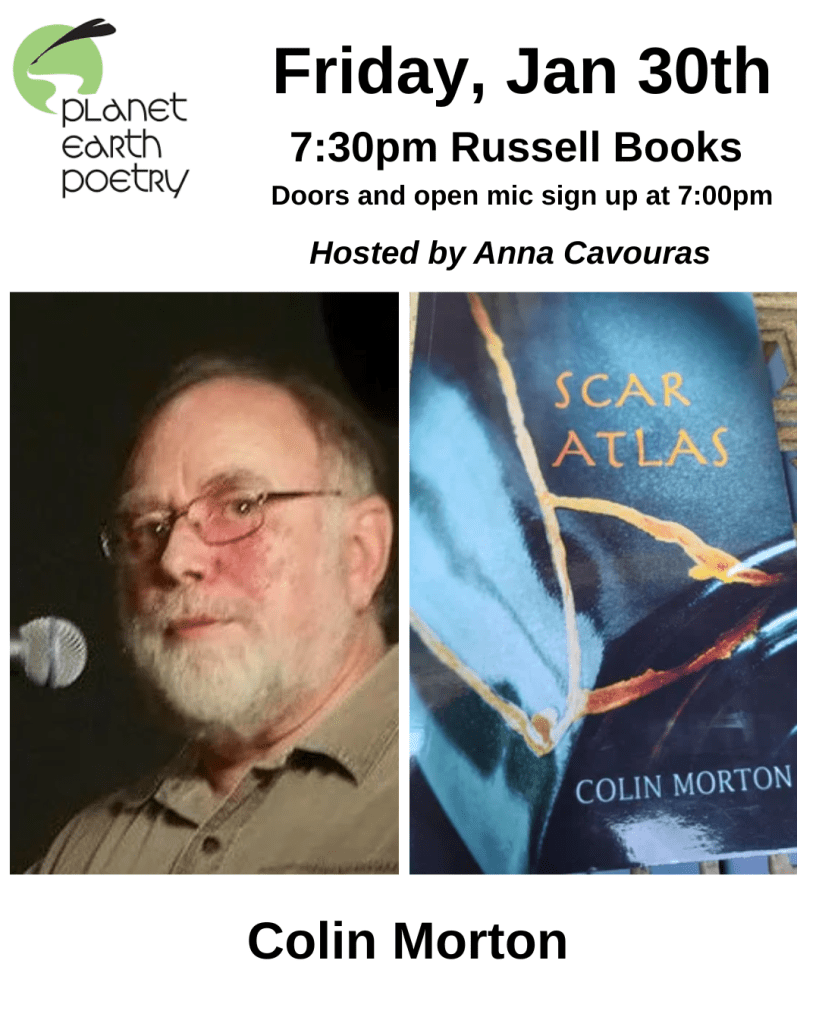

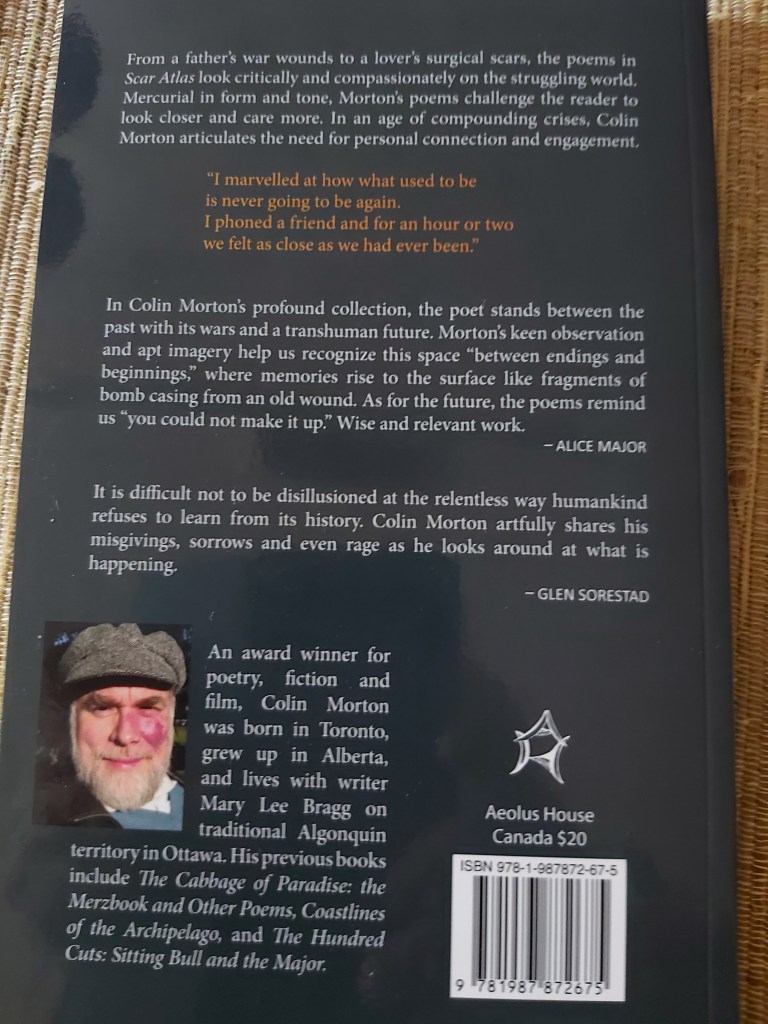
Introducing the new book of poetry by Colin Morton. Scar Atlas opens with reflections on the compounding crises of our century and ends with memories of the pandemic. In between are two personal sequences exploring the scars life leaves and the healing they represent. Order directly from colinmorton550@gmail.com and pay no tax or shipping: $20.

The Peruvian literary site Santa Rabia Poetry features five of my poems in English with Spanish translations by Colombian poet Maria Del Castillo Sucerquia. The set is called Scar Atlas.
Scar Atlas
My father leaned over the sink
to study his face in the mirror.
With a sterilized needle he probed,
prodded, nudged out a sliver
of bomb casing risen to the surface
years after he came home from war.
Field doctors had removed the larger bits,
phosphorus that glowed in the dark,
then smoothed on a sheet of skin
borrowed from his body lower down,
and when the patient regained his sight,
sent him back to the battle.
As he lay on the sofa watching TV,
his legs thrown across my lap, I traced
a route with my fingers on the map
of shrapnel scars that pitted his shins.
He watched in silence the scenes of war
staged as heroics on the small screen,
never spoke of his own, said only
that the scars no longer hurt.
Now in its 51st year of publication, West Coast literary magazine Event gave me a boost by publishing me with “six new poets” in the 1970s. I am just as pleased to be published by Event in 2023. Here are the new poems, which revisit my post-war Calgary upbringing and that time someone in England published my poems as his own. The first is a prose poem.
Arriving Late
I don’t remember what movie we saw or whether it played at the Capitol or Palace, only that my sister and I arrived late, walked in partway, and stayed for the next showing. When we reached the scene where we came in, I was ready to go but she wouldn’t leave. So I stood by myself at the bus stop downtown on a Saturday afternoon, 1959.
I couldn’t tell how old the man was, the one I’d learn to call a drunk. Shaky on his feet, he squatted beside me on the sidewalk, staring into my eyes, almost crying. He put his arms on my waist and asked me to hold him, so I reached out.
Next thing, a uniform stooped over me,. A second cop pulled the man up by the collar of his dirty coat, asking me if I knew him and did he hurt me. Frightened now, but innocent, I shook my head. More questions followed, but what stayed in my mind ‒ what I talked about later ‒ was my ride home in a police cruiser, radar on the dash, siren wailing when we stopped a speeding motorcycle.
These memories have stayed with me ever since, specific and unchanging. But something is missing from the story, something everyone else could see but I could not: the blood-red birthmark splashed across my face.
Of course the police had to check, but maybe the man on the sidewalk was no molester but the one passer-by who looked at me and cared. Run in for a show of kindness. Maybe he was a war vet, as all men seemed to be, and the sight of me brought him flashbacks of ruined towns, crying children.
I didn’t wonder about any of this then, nor afterward for many years. My memories, if fragmentary, were secure. It was the summer a neighbour’s new Edsel parked in front of our house, and when the squad car pulled up behind it, our front door stood open. My sister called out that I was late for supper, but cobs of corn were boiling on the stove.
Sunday Afternoons
Sunday afternoons my father sometimes slept till five,
weary from a week of work.
Weary too from his year at the front
of the war that defined our world.
A survivor, one of the victors, he earned his rest.
Other Sundays he would lie fully clothed on his bed
and smoke. If I passed the door he would call me,
have me lie down beside him. In silence
we lay, his arm around my shoulder, breathing slow.
I inhaled when he inhaled, exhaled when he did,
trying not to breathe his smoke.
For a few moments, a meditation, we breathed together
and after the time it might take to fall asleep
I would rise and quietly leave him
smoking, perhaps remembering.
Regalia
One week in summer, disinherited tribes
were allowed to camp as their ancestors did
where the Bow and Elbow rivers meet
and wear regalia for once-banned rituals.
Inside the stockade of Stampede grounds
we watched in awe as boys our age
arrayed in feathers and coloured beads
stamped and whirled to pounding drums
near the arena where, last winter,
between periods of a hockey game,
we Scouts performed the Musical Ride
on skates, weaving patterns on the ice.
Clumsy black costumes hung from our shoulders
like bumper cars with wooden horses’ heads,
but our privilege fit so well
we hardly knew we wore it.
Avatars
When my poems resurfaced
under another man’s name
I found second selves in cyberspace.
In the midst of a bull market …
I ran the table …
scored from mid-field …
spent a night with the Stones …
between campaigns for Palestine …
Then these chilling words.
Last seen wading into the ocean
in boxer shorts on Christmas Eve …
On site after site the headlines read
Local man missing, feared dead.

Some of my poems have been appearing online recently, one at Bywords.ca (http://www.bywords.ca/) and three more on the Poetry Super Highway (https://www.poetrysuperhighway.com/psh/poetry-from-leslie-dianne-and-colin-morton/).
The Bywords poem might get lost in the shuffle, so you may read it here:
Lost
It’s under something it’s
behind something it’s in
the right place for something else.
No it’s on something it’s
in front of something it’s where
you don’t see it because you know it’s not there.
It’s your only one it’s
always there when you need it it
will come to you in a minute.
It’s on the tip of your tongue it’s
what you used to do with whozit you know
what you were talking about just now.
Over on the Poetry Super Highway are three more poems. The first two, “Travelling” and “Nimrod,” take a sidewise view on desperate times for refugees, especially in the Middle East. This third poem looks back at a post-war childhood in Calgary.
No horses graze above the city now.
Mint and sage, the prairie’s scent remains.
Abandoned cars we found as boys,
home to families of fox or skunk,
have long-since been hauled away.
I leave the gravel path,
follow deer trails into willow brake,
through damp coulee where spring runoff pools,
look out at mountains snow-capped in the sun,
or east toward the vague horizon,
the mirage I chased so far.
On the frontier of a growing city
poised between boom and bust,
we walked to schools named for Mounties
‒ Colonel Irvine, Colonel Macleod ‒
grew up itching for a fight
or challenge, enemy or rival.
We roamed hills known for eons
to hunters who left little trace.
Wrote our initials in fresh cement,
instant fossils of the post-war boom.
We’d do anything to matter
though we saw what it did to our dads.
We climbed a slope where we cast a long shadow,
shouted our names to the wind.
In person poetry readings are starting up again. My next will be July 1 in the park at Kingston ArtFest.
It’s music day every day in my household, thanks to my wife Mary Lee Bragg.
This poem appears in the new Community anthology from Gertrude’s Writing Room.
Satie’s Gnossiennes
Day one of the lockdown she said
she would play the Gnossiennes each day
until the plague passed over and real life resumed.
Now it’s nearing day four hundred
she’s quarantined and the ICUs are full
still the light play of fingers on the keyboard
brings a few moments’ peace to her day.
It’s spring again. She opens her window
and spreads the music’s calm composure
over the socially distanced street.
Colin Morton
P.S. On World Music Day 2022, COVID-19 goes on, and so does the music.
Since summer 2021 I have been collaborating with musician and producer Alrick Huebener on a series of video poems based on my writings. Works we have completed so far include:
Tinnitus <https://www.youtube.com/watch?v=dUsWPn2wAHA>
The Weather <https://www.youtube.com/watch?v=zWWRFcch_Uk>
At a Nameless Bend in the River <a href="http://<https://www.youtube.com/watch?v=G0OQtz2G5vo" data-type="URL" data-id="<https://www.youtube.com/watch?v=G0OQtz2G5vo>
Alrick Huebener’s YouTube channel includes other video poems he has created with poets Claudia Radmore, Susan McMaster, and of course his musical collaborators.
Train poetry journal as posted my four part poem “Last Days” on its blog.
The poem once had an epigraph quoting the American poet Robert Duncan, who wrote in the 1960s, “Again and again we enter the last days of our civilization.” Fittingly, I think, “Last Days” ends with a beginning.
Last Days
1.
No one paid much mind at first.
A low murmur amid the hubbub.
When finally heard
alarms were late.
How do you stop a chain reaction
or keep calm with a fever?
2.
Many have seen the end of the world
as they knew it.
Last days before that end
must be special days.
Those living them must be special too.
We’ve always known.
3.
We do our best to be prepared
half-believe what our senses tell us.
Know one in the hand
for what it’s worth.
What’s left undone is yet to do
yet we did and did undo some things.
4.
We returned home in the waning light
chastened yet braced for new beginnings
sure we knew the way ahead
and wouldn’t make the same mistakes again.
This was not the moment for doubt.
We were of one mind, never so dangerous.
Colin Morton
Train poetry journal will include three other poems of mine in their next print journal, on sale across Canada.
A new poem of mine is online this month at Bywords.ca
It captures a bit of the loneliness and isolation that many of us are feeling in lockdown.
Updating the Address Book
So many listings scratched out
and replaced with newer ones.
Here’s another out of date,
we haven’t been in touch for years.
When we met he lived in old town,
two rooms of a red brick house
leaning toward the St. Lawrence.
He made me tea, and I wondered
if it was safe amid hanging wires
for speakers and an over-worked fan.
One table housed kettle, toaster,
laptop and printer. A bungee
cord held the fridge door shut,
and a girlfriend slept in the other room.
Each place I’ve seen him since
has been a replay of that scene.
Disorder so thorough it must
begin inside, grow soulward with age,
unless saved by some great love.
Or maybe I’m wrong, after all,
you see what you expect to see.
Maybe that first time in Montreal
gave me a label to hang on him,
and maybe the label has faded now.
I may have read it wrong from the start,
it has happened before.
I wish I could see him now.
W. Scott Olsen is turning over the editorship of Ascent magazine after 25 years, and goes out with a special issue, including some compelling work from mainly American writers. I was a colleague of Scott at Concordia College, Moorhead, Minnesota, when he took over Ascent, already established for forty years or more, and moved it from Chicago.
Here are my three poems from the issue, all rather starry eyed, with links to the rest of the issue.
Stardust
I met a woman who said she stole
her father’s ashes from her mother’s home
spread them under her father’s microscope and saw
phosphorus constellations
shining.
Event Horizon
Does anything momentous happen
in the moment everything changes,
when a falling body crosses the line
between light and dark?
In the moment everything changes
is it an event at all
between light and dark?
Like the instant in debate
(is it an event at all?)
when you realize what you’ve said
– this instant in debate –
is fatal to your cause.
When you realize what you’ve said
and all your good reasons are past recall,
it’s fatal to your cause.
Or like one of those days
when all your good reasons are past recall
and nothing seems to happen.
Or like one of those days
you later see as the decisive moment
when nothing seems to happen
as a falling body crosses the line.
Later you see it’s the decisive moment,
the moment everything happens.
Broken Windows
(poem ending with a line by Louise Glück)
Shattered glass. And within each shard
a whole world of street and sky.
My mother laughs.
My father smokes.
Outside the house, with the slam of a door,
life begins.
On winter nights Orion chases across the sky.
Rigel, Betelgeuse. What’s the other?
The walk back from the bar alone is proof
the universe is expanding.
Leaves fall, then snow.
You want to know if there’s Christmas on other planets.
And if love is the answer.
Who said anything sillier, or better?
Find solace in that. Or in the poet’s words,
“the great plates invisibly shifting and changing.”
 Colin Morton