

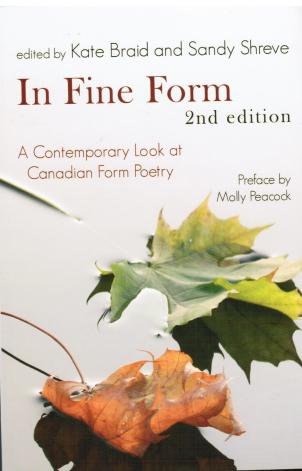
 My bionote in an issue of Grain magazine dating back to 1979 said my goal was to write in every poetic form, “sonnet, sestina, serial poem” and also the ones that don’t start with s. Four decades later, while I like to think I’m still in mid-career, I see that I have at least tried my hand at nearly every form categorized in the extra-fine new second edition of the anthology In Fine Form, edited by Kate Braid and Sandy Shreve. Their selection, from two hundred years of Canadian poetry, covers the landscape encyclopedia style: Ballad; Blues; Epigram; Found Poems; Fugue and Madrigal; Ghazal; Glosa; Haiku and Other Japanese Forms; Incantation; Lipogram; Palindrome; Pantoum; Pas de Deux; Prose Poem; Rondeau Family; Sestina; Sonnet; Spoken Word; Stanzas; Villanelle; each gets a chapter … And More. The editors take troubles to introduce the forms, many of them ancient, and review how they’ve developed under the pens and keyboards of today’s poets. Examples follow, ordered not chronologically but according to how closely the poet has followed the models, progressing toward more and more experimental interpretations.

It’s a bit alarming how comfortably my roundeau (or roundel?) from “Three Small Rooms” sits beside John McCrae’s “In Flanders Fields.” “We are the Dead,” he declares, and the only thing missing is my date of death. Given the elephant in my “Small Room” though, it could come directly from Kipling. I wrote the piece, with others, as an exercise upon finding Lewis Turco’s Book of Forms twenty years ago. Like many of the poets in the anthology, I don’t think of myself primarily as a “formal” poet. Often, we aren’t represented in the anthology by our most characteristic work. But there are fine discoveries here, including the fact that poets, while blazing trails through the thicket of language, aren’t burning bridges. There’s a deep heritage of poetry, a renewable resource for a poet to draw on, and look, it’s still possible.
Looking back to 1979 and beyond, I realize that, yes, form has always been at least as important in my poetry as metaphor (not that I’d tear the wings off that fly). Poetry is ordered speech, ordered language. What it says matters. The way it’s said – its form – is poetry.
-
Colin Morton


 Colin Morton